
How Long Does a Concrete Driveway Last in North Texas?
The national average for concrete driveway lifespan is 25–50 years. In North Texas, that range compresses on the lower end when concrete is poured to minimum spec on expansive clay soil — and extends well beyond the upper end when construction is done properly. Understanding what determines which end of that range your concrete lands on is the difference between a driveway you replace once and one you replace three times over a lifetime of homeownership in Benbrook.
Concrete Built to Last in Benbrook TX
We build concrete to the spec that hits the high end of the lifespan range. Call (888) 376-0955 for a free estimate.
The Two Concrete Lifespans in North Texas
There are essentially two concrete products being installed in Benbrook and the greater Fort Worth area, even though they look identical when freshly poured:
Standard-spec concrete (minimum viable):
- 3-4 inch slab
- Fiber mesh or light wire mesh reinforcement
- Minimal or no gravel base
- Basic broom finish, no sealer
- Expected lifespan: 10–20 years
Properly specified concrete:
- 4–5 inch slab minimum (6+ for heavy loads)
- Rebar #3 on 18-inch centers
- 4–6 inch compacted gravel base
- 3,500+ PSI concrete mix
- Control joints at appropriate spacing
- Penetrating sealer applied and maintained
- Expected lifespan: 30–50+ years
The price difference between these two products is roughly $1–$2/SF. On a 600 SF driveway, that’s $600–$1,200. Over a 30-year ownership period, the homeowner who chose standard spec may have replaced their driveway twice ($8,400–$12,000 total) while their neighbor who paid the premium is still on their original pour.
What Shortens Concrete Lifespan in Benbrook
Expansive clay soil contact: Concrete poured directly on Benbrook’s Blackland Prairie clay — without a gravel base buffer — is in direct contact with a material that moves up to 7 inches seasonally. The clay’s shrink-swell cycle applies direct stress to the slab with every moisture cycle. Properly installed gravel base isolates the concrete from this movement.
Inadequate reinforcement: The soil movement in Tarrant County creates tensile stress in concrete slabs that fiber mesh doesn’t adequately resist. Rebar provides the tensile reinforcement that holds the slab together when clay movement creates bending stress. Concrete without rebar in clay soil conditions cracks through the full slab depth faster than reinforced concrete cracks at surface level.
Missing or undersized control joints: Control joints are intentional weaknesses engineered into the concrete to direct cracking to controlled, repairable locations rather than random cracking across the slab surface. Joints spaced too far apart, or sawed too shallow, don’t function as designed — cracking occurs at random locations instead of at joints.
No drainage management: Concrete that regularly has water pooling at its edges is bathing the adjacent clay in moisture that drives swelling. Even well-built concrete accelerates its cracking timeline when drainage allows water to consistently saturate the sub-base clay.
Delayed sealing: Unsealed concrete in Benbrook’s UV-intense environment loses surface paste integrity over time as the cement binder degrades. Regular sealing every 3–5 years blocks moisture penetration and UV degradation — the two primary pathways for surface spalling.
Get the Long-Life Specification in Benbrook
Concrete built right the first time lasts 30–50 years. Free estimates — call (888) 376-0955.
Lifespan by Concrete Type in Benbrook
Concrete driveways: 30–50 years properly built; 10–20 years minimum spec. Driveways in Tarrant County that receive heavy vehicle loads (trucks, RVs) should be built to 5-inch thickness minimum for longevity at the high end of that range.
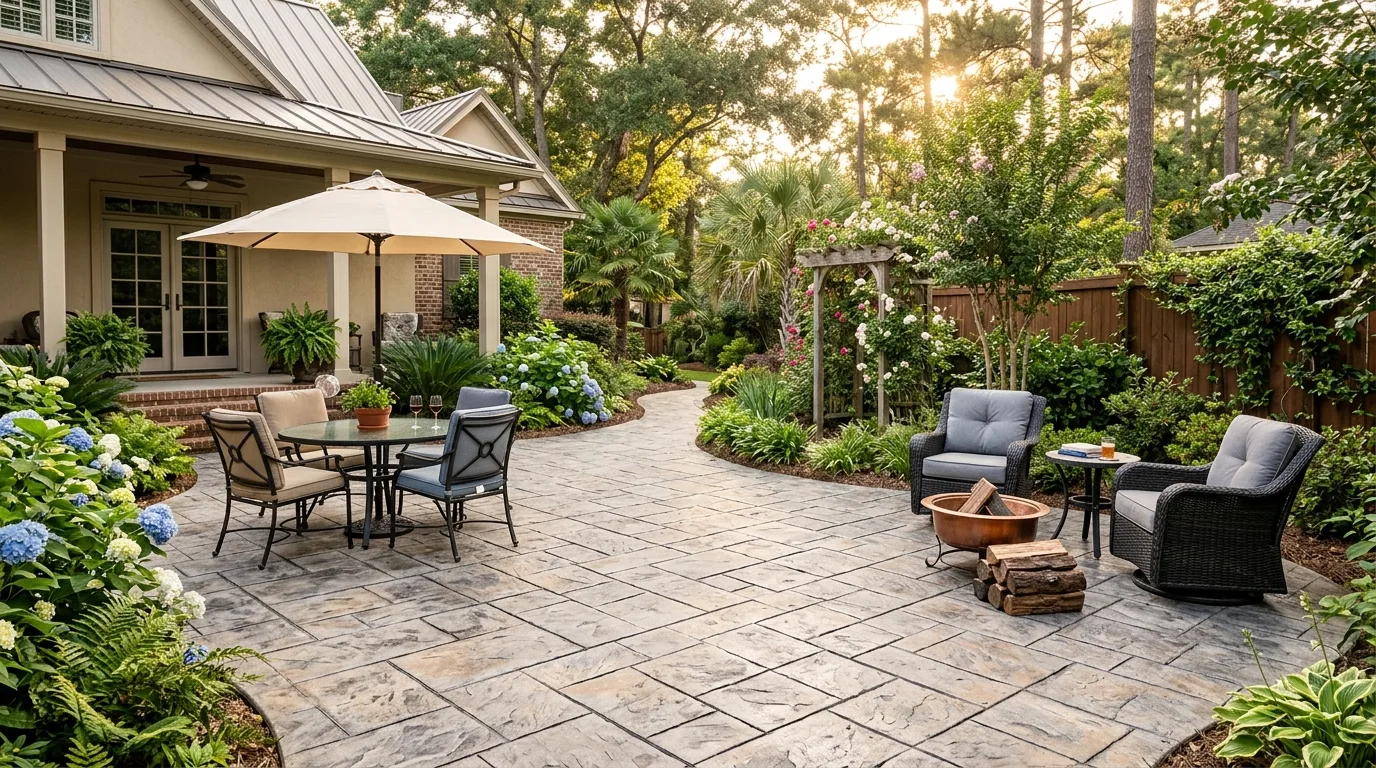
Concrete patios: 25–40 years properly built. Patios generally see lighter loads than driveways, but the same soil conditions apply. Patios with decorative stamped surfaces need regular resealing (every 2–3 years) to maintain color — the structural concrete underneath the color surface typically outlasts the finish.
Concrete slabs (garage, workshop): 40–60 years properly built under normal use. Slabs that serve as floors for workshops with heavy equipment or vehicle storage should be built to 5–6 inch thickness with heavier reinforcement. Standard 4-inch residential slab spec under heavy forklift or equipment use will crack faster.
Foundation concrete: The structural concrete in a properly built home foundation should last the life of the structure — 75+ years. Foundation problems in Benbrook aren’t typically concrete failures; they’re sub-base failures caused by clay soil movement that the foundation’s drainage system didn’t adequately manage.
Concrete sidewalks and walkways: 20–35 years properly built. Walkways are vulnerable to root intrusion from trees — particularly in Westpark Estates and North Benbrook where established trees have extensive root systems that can infiltrate slab edges and cause cracking and heaving.
Maintenance Timeline That Maximizes Concrete Lifespan
The homeowners who hit the high end of the lifespan range in Benbrook follow a simple maintenance schedule:
Year 1–2: Initial sealing after the concrete is fully cured (minimum 30 days for the first seal). This locks in moisture resistance during the critical early period.
Every 3–5 years: Reseal with penetrating silane sealer. This is the single most impactful maintenance action for concrete longevity. Takes an afternoon and costs $200–$500 for a typical driveway or patio.
Annually: Inspect for cracks wider than hairline. Fill any cracks that have reached 1/8 inch or wider with flexible polyurethane before they widen. The cost of early crack filling is a small fraction of the cost of addressing the same crack after it has compromised the sub-base.
After each wet season: Inspect for drainage problems — pooling at slab edges or against structures. Address drainage issues before they lead to sub-base saturation. See our guide on top concrete repair signs for Benbrook homeowners for what to look for.
Practical Uses
New home buyers in Benbrook: When evaluating a Benbrook home with an existing concrete driveway, ask about age and construction spec. A 15-year-old driveway with visible cracks may be at the end of its life on minimum spec, or only at midlife on proper spec. Inspection reports rarely distinguish between the two — ask the seller for contractor documentation or budget for replacement if the spec is unknown.
Homeowners in Timbercreek Estates and Trinity Estates: These neighborhoods have active clay profiles and established tree canopy, both of which accelerate concrete aging. Homeowners here should be on a 3-year sealing schedule rather than 5-year, and should monitor for root intrusion at walkway edges annually.
Investment property owners in Benbrook: For rental properties, the cost of concrete replacement is a capital expense with a long replacement cycle when concrete is properly built. Choosing minimum spec to save $1,500 upfront and facing replacement in 10–15 years is poor investment math on a property you plan to hold.
Pre-sale preparation: If your Benbrook home has concrete that’s 20+ years old, an honest assessment of remaining lifespan helps you decide whether to replace before listing (capturing the value) or disclose remaining life and price accordingly. Fresh concrete is consistently one of the highest-ROI exterior upgrades for home sale.
New construction choices: If you’re building or adding structures in Benbrook, the concrete spec decision should happen at the bid evaluation stage. Contractors offering bids significantly below others are typically doing so on thinner concrete or less base preparation. The 30-year lifespan premium is worth evaluating carefully against short-term savings.
Frequently Asked Questions
How long does a concrete driveway last in Benbrook TX?
A properly built concrete driveway in Benbrook lasts 30–50 years. The key construction factors are: rebar reinforcement (#3 on 18-inch centers minimum), compacted gravel base (4–6 inches), 3,500+ PSI concrete, and appropriate control joint spacing. Minimum-spec concrete on Benbrook’s clay soil without proper base preparation typically lasts 10–20 years before requiring replacement. See our concrete driveway service page for the full specification we use.
What shortens concrete life most in North Texas?
The biggest shorteners of concrete lifespan in North Texas are: direct clay soil contact without a gravel base buffer, inadequate reinforcement for the soil movement level, poor drainage that repeatedly saturates the sub-base, missing or undersized control joints, and no sealing maintenance. Any one of these factors significantly reduces lifespan; multiple factors compound. North Texas concrete that hits all five failure modes rarely makes it past 15 years.
Does concrete or asphalt last longer in North Texas?
Concrete outlasts asphalt significantly in North Texas conditions. Properly built concrete lasts 30–50 years; properly maintained asphalt lasts 15–25 years in the same conditions. North Texas’s high summer temperatures cause asphalt to soften, which accelerates rutting and edge deterioration. Clay soil movement creates similar challenges for both materials, but concrete’s predictable cracking behavior is easier to manage than asphalt’s deformation. See our concrete vs. asphalt comparison for Benbrook for a full breakdown.
Build Concrete That Lasts in Benbrook
We spec every project for the 30–50 year end of the range. Call (888) 376-0955 for a free estimate.
Related: