
Top 5 Concrete Repair Signs for Benbrook Homeowners
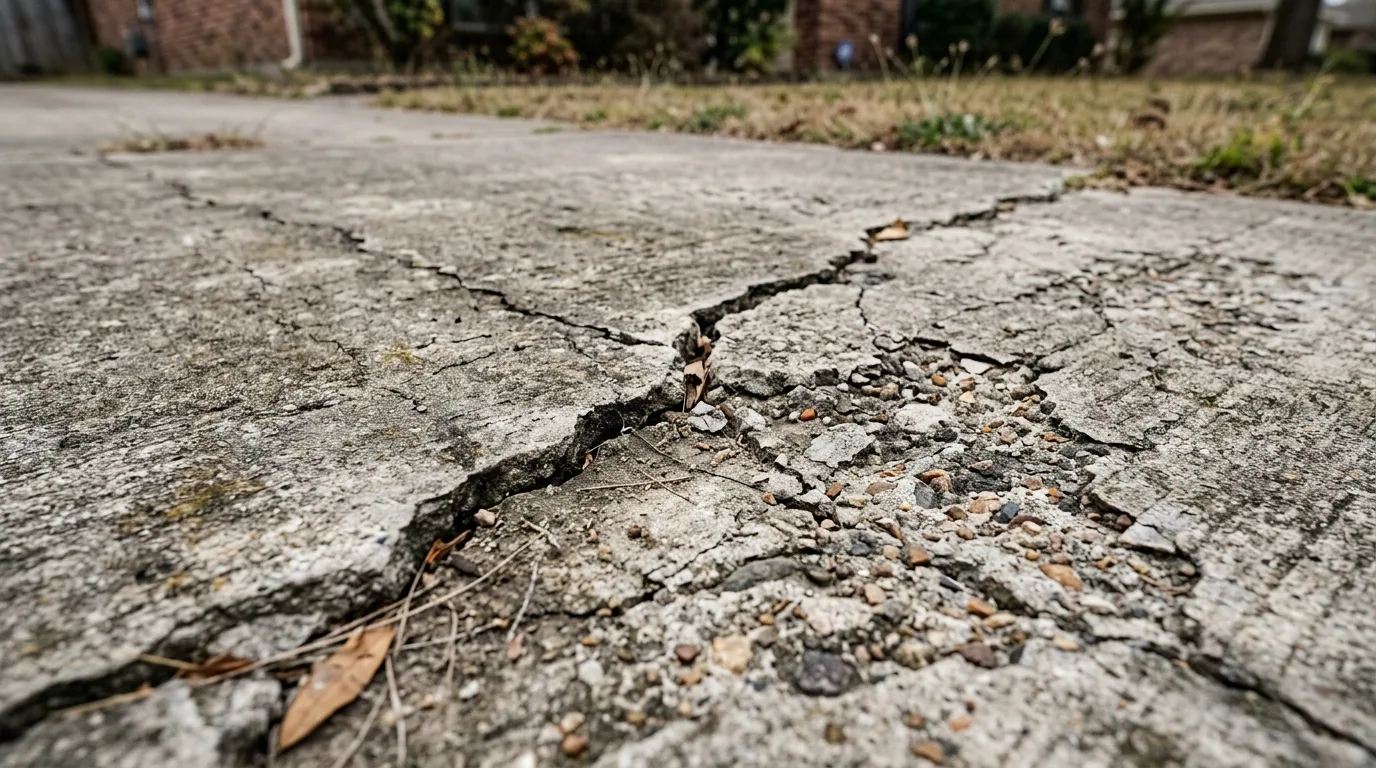
In Benbrook’s Blackland Prairie clay soil, the cost of delayed concrete repair isn’t just the inconvenience of waiting — it’s real money. A crack that costs $400 to fill in May becomes a $1,200 repair by October if it’s allowed to widen through a summer drought-and-rain cycle. Know which warning signs demand immediate action, and you’ll avoid the pattern of paying several times the repair cost for the same problem a year or two later.
These are the five warning signs Benbrook homeowners most commonly ignore — and shouldn’t.
Free Concrete Assessment in Benbrook
Don't wait for a small repair to become a big replacement. Call (888) 376-0955 for a free, honest assessment.
Sign 1: Cracks Wider Than 1/4 Inch
Hairline cracks in concrete are common and often cosmetic — thermal expansion and contraction, initial curing shrinkage, and minor soil movement all produce fine surface cracks that don’t indicate structural problems. The threshold that changes everything is 1/4 inch (about the width of a pencil).
Cracks wider than 1/4 inch have allowed water to reach the sub-base. In Benbrook’s clay soil environment, that water is doing active damage: each wet cycle saturates the clay directly below the crack, increasing swelling pressure on the surrounding slab sections; each dry cycle creates voids as the clay shrinks away. The crack widens with each cycle. What started as a 1/4-inch gap becomes 1/2-inch within a season or two, and at that width, the crack has compromised the structural integrity of the slab section.
What to do: Get a concrete repair assessment from a contractor familiar with Tarrant County conditions. A crack at 1/4 inch can often be filled with flexible polyurethane or epoxy for $200–$600. The same crack at 1/2 inch may require more extensive repair or partial slab replacement.
Benbrook-specific note: The spring-to-summer transition in Benbrook — heavy May rainfall followed by July–August drought — is when cracks widen fastest. Inspect your concrete in June before the peak summer heat accelerates the widening process.
Sign 2: Sections That Have Shifted Vertically
When sections of a concrete driveway, patio, or walkway have moved to different heights — creating a “step” where there was previously a flush joint — the sub-base has failed. This is called differential settlement, and it means the clay or gravel base beneath one section has shifted or compacted unevenly.
Vertical displacement above 1/4 inch creates a trip hazard. Above 1 inch, it indicates significant sub-base failure that makes surface-only repair impractical. At the homes in Hilltop Heights and North Benbrook where we see this most often, the vertical step is usually caused by clay shrinkage during the summer drought pulling away from the underside of one slab section while the adjacent section remains supported.
What to do: Sections with vertical displacement of 1/4–3/4 inch can sometimes be addressed with mudjacking — pumping grout beneath the slab to fill voids and raise the settled section. Displacement over 1 inch, or sections where the vertical step has been present for multiple seasons, typically requires slab section replacement. See our concrete repair service page for more on repair vs. replacement assessment.
Sign 3: Concrete That Rocks or Flexes Underfoot
If you can feel a concrete slab section flex or rock slightly when you walk across it, there’s a void beneath it. The slab is now spanning the void like a bridge — under load, it flexes because there’s no support underneath.
This situation needs attention immediately. Concrete is not designed to flex. Every time someone walks or drives over a slab with a void beneath it, the concrete is experiencing stress it wasn’t designed to handle. The slab will crack at the point of maximum stress — usually at control joints or slab edges — and the failure can happen suddenly rather than gradually.
What to do: Mudjacking — pumping grout or flowable fill beneath the slab to fill the void — is the typical solution and is much less expensive than full replacement if the slab surface is still structurally sound. The void needs to be filled before the slab cracks through, not after.
Don't Wait on Concrete Problems in Benbrook
We assess and repair concrete damage before it turns into replacement costs. Call (888) 376-0955.
Sign 4: Water Pooling After Rain
Water pooling on or adjacent to a concrete surface after rain is a drainage failure. It’s significant not just because standing water is unpleasant — it’s significant because every time water pools, it saturates the clay soil beneath and adjacent to the slab, intensifying the seasonal swelling that causes cracking and settlement.
Benbrook receives 35.57 inches of rain annually, concentrated in May and secondarily in September. A drainage problem that allows water to pool after every rain event is creating sub-base saturation 30+ times per year in a good rainfall year. That’s 30+ clay swelling cycles in addition to the shrinkage cycles during dry months. The cumulative damage is significant.
What to do: Some pooling is addressable with crack filling and minor surface correction. Significant drainage failures — where water consistently runs toward the house foundation instead of away, or pools in the same location regardless of crack repair — require drainage correction as part of the repair scope. This may mean regrading the surface, adding drainage channels, or extending drainage outlets.
Benbrook-specific priority: Pooling adjacent to a house foundation is particularly urgent. Water that accumulates against the foundation saturates the clay soil directly below the slab, accelerating differential foundation movement. See our foundation repair guide if you’re seeing pooling against the foundation.
Sign 5: Spalling or Flaking Concrete Surface
Spalling is when the concrete surface breaks away in flakes, chips, or larger chunks — exposing the aggregate underneath. It’s usually caused by one of three things: freeze-thaw damage (water in the surface layer freezes and expands, breaking the surface paste), deicing salt damage (rare in Benbrook), or UV degradation on unsealed concrete exposed to North Texas’s intense sunlight.
Once spalling begins, it accelerates. The exposed aggregate surface collects water more readily than intact concrete, increasing moisture infiltration, which increases freeze-thaw damage during Benbrook’s occasional winter events. The surface gets rougher and more porous with each year of neglect.
What to do: Early-stage spalling — surface flaking over less than 25–30% of the slab — can be addressed with polymer-modified mortar patch repair, followed by sealing to protect the repaired surface. Widespread spalling over the majority of a slab surface typically makes full concrete resurfacing the most cost-effective solution. Resurfacing applies a bonded overlay to the entire surface, addressing appearance and protecting the structural concrete beneath it.
Prevention note: Sealing your concrete with a quality penetrating silane sealer every 3–5 years is the most effective prevention for spalling on Benbrook concrete. It takes surface damage off the table as a maintenance concern.
Practical Uses
Annual concrete inspection: Walk your driveway, patio, walkways, and any other concrete surfaces once in June (after spring rain, before peak summer) and once in October (after summer drought, before winter). These two points in Benbrook’s climate cycle reveal damage at its worst — the June inspection catches swelling-related cracks, and the October inspection catches shrinkage-related settlement.
Pre-winter preparation: October is the ideal time for crack filling in Benbrook — temperatures are moderate, curing is consistent, and filling cracks before any winter freeze events prevents freeze-thaw widening.
Before selling a home in Benbrook: Concrete damage is consistently flagged in home inspections. Trip hazards from vertical displacement and significant cracking are material defects that require disclosure and negotiation. Addressing them before listing is almost always more cost-effective than accepting price concessions.
After a wet spring: Inspect concrete after Benbrook’s May rain peak. New cracks that appeared during the wet period should be addressed before summer drying widens them. May is Benbrook’s wettest month at 4.1 inches average — new concrete problems showing up in June are often traceable to spring soil saturation.
For patios near Benbrook Lake: Lake-adjacent properties in Benbrook Lakeside should inspect retaining walls for drainage failure signs (efflorescence on the wall face, wall tilting outward) alongside standard concrete inspection. Retaining wall drainage problems are often visible in Benbrook’s spring wet season.
Frequently Asked Questions
How do I tell if my Benbrook concrete needs repair or replacement?
Repair makes sense for isolated cracks under 1/4 inch, surface spalling covering less than 30% of the slab, and minor settlement under 1/2 inch. Replacement is usually necessary when cracks are widespread through the full slab depth, vertical displacement exceeds 1 inch, drainage can’t be corrected without regrading the entire surface, or the existing slab was poured without adequate reinforcement or base prep. See our concrete repair Benbrook page for what the assessment process looks like.
How much does concrete repair cost in Benbrook?
Crack fills run $200–$600. Patch repairs for spalled sections cost $300–$900. Full concrete resurfacing runs $3–$6/SF — a 600 SF driveway resurface costs $1,800–$3,600. Early-stage repairs in Benbrook’s clay soil cost significantly less than late-stage repairs on the same damage. See our Benbrook concrete cost guide for full pricing.
Can I fill concrete cracks myself in Benbrook?
Small hairline cracks can be filled with consumer-grade polyurethane caulk as a short-term measure. However, for cracks wider than 1/8 inch, the cause of the crack is as important as the fill — if the crack is driven by drainage problems or sub-base failure, a DIY fill will re-open within a season. For any crack wider than 1/4 inch or showing vertical displacement, a professional assessment ensures the right repair approach is chosen.
Act Before Small Repairs Become Big Costs
Free concrete assessments in Benbrook — we'll tell you honestly what you're dealing with. Call (888) 376-0955.
Related: