
Benbrook's Clay Soil: Why Reinforced Concrete Is Non-Negotiable
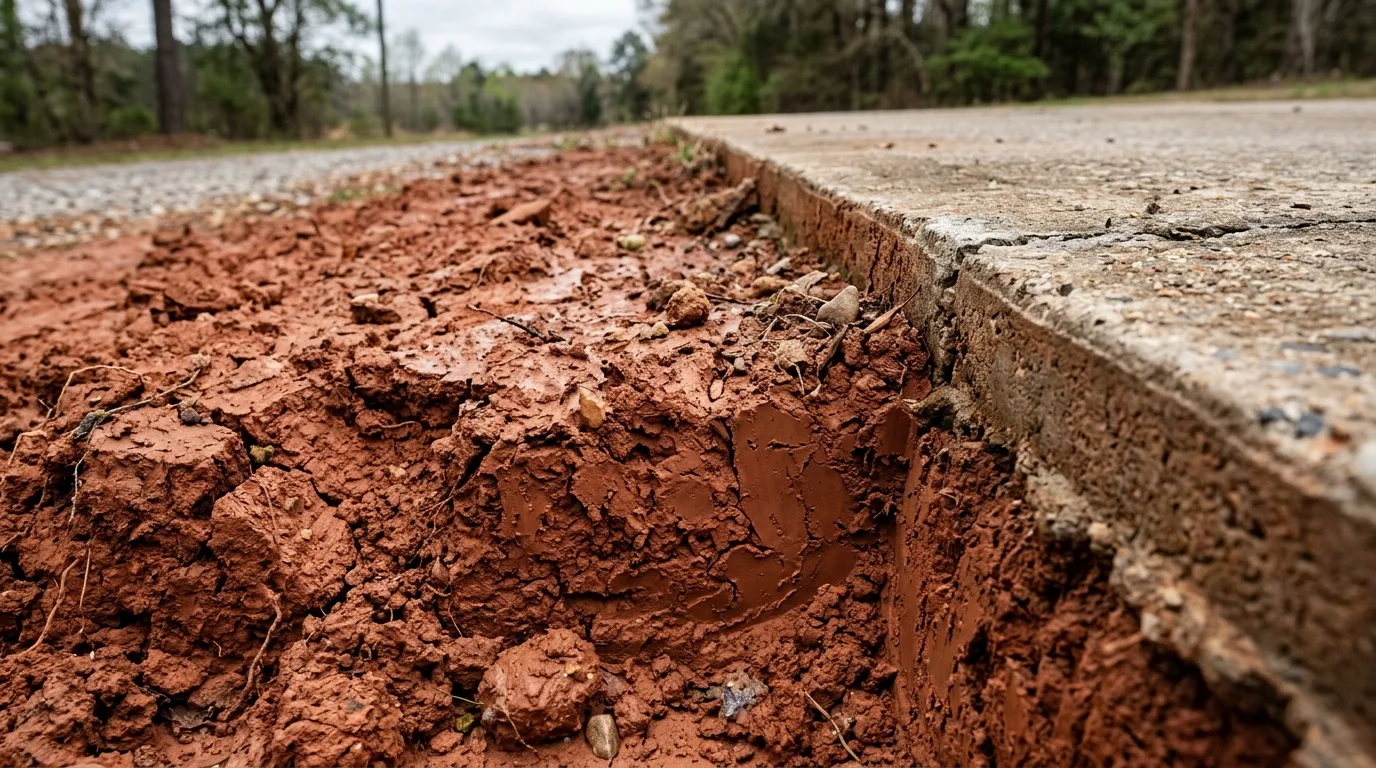
If you’ve had a concrete driveway, patio, or sidewalk crack within a few years of installation in Benbrook, clay soil is almost certainly the reason. Benbrook’s Blackland Prairie clay is classified as one of the most expansive soil types in North Texas — and it’s directly responsible for the pattern of cracked and settled concrete that homeowners throughout Tarrant County deal with every season.
In this post, we cover what makes Benbrook’s soil different, exactly how it damages concrete, and what proper construction technique looks like for clay soil conditions.
Concrete Built for Benbrook's Clay Soil
Every project we pour uses the right mix, rebar, and base prep for North Texas conditions. Call (888) 376-0955 for a free estimate.
Why Benbrook’s Clay Soil Is Uniquely Challenging
Benbrook sits on Blackland Prairie soil, a geological formation dominated by montmorillonite clay minerals. These minerals have a layered crystal structure that allows water molecules to penetrate between layers — causing the clay to swell dramatically as it absorbs water and shrink as it dries. This process is called “shrink-swell” behavior, and Benbrook’s soil exhibits it in extremes.
The numbers are significant: Blackland Prairie clay can expand vertically up to 7 inches with moisture changes and exert up to 15,000 pounds per square foot of upward pressure when saturated. Over 50% of North Texas soils share this expansive clay characteristic. Tarrant County’s active clay profile is among the most problematic in the state — it’s why foundation movement and concrete cracking are far more common here than in most other parts of the country.
Neighborhoods like Timbercreek Estates and Trinity Estates, which sit on particularly active clay profiles within Benbrook, see this pattern most acutely. Homeowners who’ve replaced a driveway or patio more than once are often dealing with the same soil condition each time — and getting the same insufficient base preparation.
How Clay Soil Damages Concrete Slabs
The damage mechanism is simple to understand: concrete is a rigid material that can’t flex. When the clay soil beneath a concrete slab swells during wet periods, it pushes the slab up — creating stress at fixed points like control joints and slab edges. When the clay shrinks during dry periods (Benbrook’s July–August drought period is particularly pronounced), it pulls away from the underside of the slab and creates voids. The slab, now unsupported at the void location, cracks under load.
This cycle repeats every year. Benbrook’s May rainfall peak (4.1 inches monthly average) drives rapid clay swelling. The July–September dry period drives shrinkage. Each cycle adds cumulative stress to the concrete. Slabs poured without proper reinforcement — rebar that provides tensile strength when the concrete is stressed in tension — crack first at the weakest points: control joints that aren’t properly designed, slab edges, and any area where the sub-base is thinner.
The freeze-thaw cycle is a secondary accelerant. Benbrook doesn’t freeze often, but when temperatures drop below 32°F — which happens most winters — water that has infiltrated existing cracks expands by about 9% when it freezes, widening cracks. After just a few freeze cycles, a hairline crack can become a quarter-inch gap that allows soil water to reach the sub-base and begin erosion.
Ready to Fix or Replace Your Concrete in Benbrook?
We build every project to handle Tarrant County's clay. Free estimates — call (888) 376-0955.
What Proper Concrete Construction Looks Like on Clay Soil
Understanding the problem makes the solution clear. Properly built concrete on Benbrook’s clay soil requires:
Excavation depth: Enough depth to accommodate both the gravel base and the concrete thickness without sitting in or near the active clay zone. For a standard 4-inch driveway or patio, that typically means excavating 8–10 inches below finished grade.
Compacted gravel base: A 4–6 inch layer of crushed limestone or similar granular material compacted to 95% proctor density. This layer doesn’t absorb water the way clay does, which breaks the direct connection between the clay’s moisture cycles and the concrete slab above. Without this layer, the slab sits directly on clay and moves with it.
Reinforcement: #3 rebar on 18-inch centers minimum, placed at approximately the midpoint of the slab thickness. Rebar provides tensile strength that concrete lacks — when the slab is stressed in tension from soil movement below, the rebar carries that load and prevents cracking through the full slab depth. Fiber mesh is sometimes used in addition to rebar but should not replace it on expansive clay sites.
Concrete mix: 3,500 PSI minimum for residential applications in North Texas. Higher strength concrete has a denser matrix that resists moisture penetration and surface scaling better than lower-strength mixes.
Control joints: Tooled or saw-cut at 8–10 foot intervals maximum (smaller spacing in high-risk areas). Control joints create intentional weak points that direct any future cracking to a predictable, manageable location rather than allowing random cracking through the slab surface.
Drainage: Positive slope away from structures (minimum 1/8 inch per foot), proper grading to direct runoff away from the slab edge, and diverters or drainage channels where needed to prevent water from pooling adjacent to the concrete.
Practical Uses
Concrete driveways on clay soil: Rebar reinforcement is non-negotiable for residential driveways in Benbrook. A driveway poured with fiber mesh only on clay soil typically shows cracking and differential settlement within 3–7 years. Properly reinforced driveways on a compacted base regularly last 30+ years.
Concrete patios near Benbrook Lake: Properties adjacent to the 3,770-acre Benbrook Lake have elevated moisture levels in the soil, amplifying clay swelling during wet periods. Drainage design for patios in the Benbrook Lakeside neighborhood is particularly critical.
Concrete slabs for garages and workshops: Garage slabs in Hilltop Heights and North Benbrook see the same clay soil conditions. Heavy vehicle loads on an undersized slab accelerate the cracking timeline significantly.
Retaining walls and steps: Vertical concrete elements are particularly vulnerable to clay soil pressure. Retaining walls must be engineered with drainage behind them to relieve hydrostatic pressure from saturated clay.
Foundation concrete: Home foundations in Trinity Estates and Westpark Estates require pier systems that extend below the active clay zone — typically 15–25 feet in Tarrant County — to reach stable bearing soil.
Commercial flatwork: I-20 corridor businesses deal with the same clay soil conditions as residential properties. Commercial parking lots and loading docks on inadequate bases fail faster under heavy vehicle loads.
How to Verify Your Contractor Is Doing It Right
When getting bids for any concrete project in Benbrook, ask each contractor:
- How deep will you excavate?
- How thick will the gravel base be, and what material?
- What size rebar will you use, and at what spacing?
- What PSI concrete will you specify?
- How will you handle drainage from the new slab?
A contractor who answers these questions with confidence and specifics is one who understands Benbrook’s conditions. A contractor who gives vague answers or proposes fiber mesh only on a clay soil site is cutting corners that will cost you in a few years.
Frequently Asked Questions
Why does concrete crack so quickly in Benbrook?
The primary cause is expansive clay soil — Benbrook’s Blackland Prairie clay moves up to 7 inches vertically with seasonal moisture changes, stressing concrete that isn’t reinforced or supported by a proper base. Without rebar reinforcement and a compacted gravel base, concrete sits directly on moving clay and cracks within a few seasons. Proper construction — rebar, gravel base, 3,500+ PSI concrete — produces concrete that lasts 30+ years in the same conditions.
Does clay soil affect foundation concrete in Benbrook?
Significantly. Tarrant County’s expansive clay is the primary driver of foundation movement across the Benbrook area. Homes on clay soil without proper foundation drainage routinely develop differential settlement — where one section of the foundation moves differently than another, causing structural distress visible as stair-step cracks in brickwork, sticking doors, and floor slope. Foundation repair on clay soil requires piers extending below the active clay zone to stable bearing soil. See our foundation repair service page for more detail.
How much does proper base preparation add to concrete cost in Benbrook?
Proper base preparation — excavation, compacted gravel, rebar — adds roughly $1–$2/SF compared to minimum-spec work. On a 600 SF driveway, that’s $600–$1,200 more upfront. That same driveway, if poured without proper base prep on Benbrook’s clay, will likely need replacement in 10–15 years at a cost of $4,200–$6,000. The math strongly favors proper construction from the start.
Build It Right the First Time in Benbrook
Every project we pour uses rebar, proper base prep, and 3,500+ PSI concrete specified for North Texas clay. Call (888) 376-0955.
Related: